Directly supported by surviving contemporary records or strong archaeological evidence.
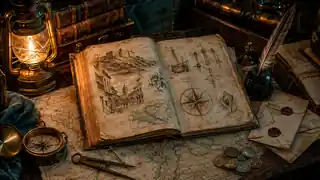
FORTUNE & GALLOWS · HISTORICAL COMPANION
The Real World of the Golden Age of Piracy
1715–1725 · Collector’s Edition Expanded Manuscript
A historical companion to the world of Fortune & Gallows, built around the ships, ports, workers, laws, markets, weather, labor systems, beliefs, information networks, and human lives that made the pirate age possible.
27 Chapters6 PartsPrimary & Institutional SourcesEvidence Confidence Standards
“The goal is not to strip wonder from the period. It is to put the wonder on firmer ground.”From the Historical Companion manuscript
ABOUT THE BOOK
History is fixed.
Knowledge is not.
The companion begins with the same problem that drives the game’s historical simulation: what could a person in the Caribbean actually see, know, do, fear, misunderstand, and survive? Events remain fixed in history. Knowledge moves at the speed of ships, letters, rumor, literacy, language, access, trust, and time.
1715–1725Core historical period examined by the book.
6 × 9Collector-edition trim target described in the manuscript.
160–200 pagesIllustrated-edition target depending on plates, paper, and typography.
Living historyShips, labor, law, ports, weather, commerce, piracy, belief, and ordinary life.
HOW THE BOOK TREATS EVIDENCE
Not every pirate story deserves the same certainty.
The manuscript explicitly separates direct evidence, strong inference, representative reconstruction, and disputed tradition so vivid storytelling does not quietly become false certainty.
Not recorded in the exact scene described, but supported by multiple period practices and local conditions.
A carefully built example of how a documented system could work without pretending a specific undocumented incident occurred.
A claim dependent on later retellings, weak sources, or evidence that cannot presently support certainty.
The manuscript’s confidence rule is simple: state strong contemporary evidence plainly, label probable conclusions as probable, use reconstructions transparently, and leave colorful but weakly supported tradition labeled as tradition.
TABLE OF CONTENTS
From peace treaties to the gallows.
The book moves from the postwar Caribbean into the working life of ships, the pirate economy, imperial systems, major historical turning points, and the material details of everyday life.
Part IA Caribbean After War
- Peace Creates Pirates
- The Sea Is the Road
- Seven Ports, Seven Different Worlds
- Storms, Reefs, and Hurricane Season
Part IIThe Wooden World
- The Ship Under Your Feet
- Rope, Sail, Wind, and Work
- Navigation, Pilots, and Finding Land
- Food, Sleep, Discipline, and Sickness
- Fighting a Ship
- Fire, Flooding, Grounding, and Wreck
Part IIIPirates and the Pirate Economy
- Money, Wages, Prices, and Plunder
- Becoming a Pirate
- Nassau Before Rogers
- Articles, Shares, Captains, and Quartermasters
- Taking a Prize
- Blackbeard, Vane, Bonnet, Rackham — and the Problem of Famous Pirates
Part IVEmpire, Commerce, and the Gallows
- Slavery, Trade, Smuggling, and the Atlantic Machine
- Lives Outside the Legend
- Pardon, Trial, and Gallows
- News, Rumor, and the Information Sea
Part VWhen History Happens Around You
- The 1715 Fleet Disaster
- 1718 — The Year the Net Tightened
- The Closing Years, 1719–1725
Part VILiving the World
- Clothing, Weapons, and Personal Possessions
- Taverns, Gambling, Shore Leave, and Religion
- Flags, Papers, Names, and Identity
- Pirate Hunters: Navy, Governors, Militias, and Informers
Epilogue — What the Pirate Flag Hides
Followed by appendices, gazetteer, glossary, and sources.
A DIFFERENT KIND OF PIRATE BOOK
The legend is only the surface.
Ships are workplaces. Hulls, rigging, pumps, food, sleep, sickness, navigation, repair, fire, flooding, and wreck matter as much as cannon smoke.
Ports are different worlds. Nassau, Havana, Kingston, Port Royal, Charles Town, St. Augustine, Santo Domingo, and the wider Caribbean cannot be reduced to one generic “pirate town.”
Piracy sits inside empire and commerce. Wages, slavery, smuggling, trade, pardon, prosecution, governors, naval patrols, and information networks shape the choices people can make.
Ordinary lives remain visible. Craftsmen, pilots, clerks, priests, widows, enslaved people, free Black mariners, Indigenous communities, merchants, soldiers, fishermen, and laborers belong to the same historical world.
RESEARCH FOUNDATIONS
Built from records, archaeology, and institutions.
The manuscript emphasizes that sources are interested evidence: trials, government letters, newspapers, printed narratives, archaeology, proclamations, and institutional research each reveal different things and each have limits.
COLLECTOR’S EDITION PRODUCTION VISION
A physical companion, not an oversized game manual.
The expanded manuscript is designed around a 6 × 9 inch trim and is structured to accept archival-style maps, ship diagrams, facsimile details from public-domain records, and original commissioned illustrations. The manuscript recommends a sewn or high-quality perfect-bound hardcover treatment with a restrained two-color interior for a final crowdfunding edition.
The Historical Companion is meant to make the boundary between fiction and history clearer — not blur it.